
Summary: Bilingual education doesn’t make children smarter. It’s a common claim, but the research doesn’t back it up. We asked Oxford-based specialist Dr Eowyn Crisfield what does hold up, and the real benefits turned out to be linguistic and social rather than cognitive. Bilingual children find it easier to pick up further languages, and they grow into confident communicators who move naturally between people and cultures.
A few things worth knowing before you read on:
- A bilingual brain doesn’t switch languages. It dims one and lifts the other, in a constant workout for executive control.
- There’s no single best bilingual model. What works depends entirely on the children in the room, not a template imported from elsewhere.
- The home language matters more than most parents assume. Weaken it, and the new language often struggles too.
- Don’t force it. A child who resists a language rarely benefits from being pushed towards it.
Ask any parent who raises a child in more than one language, and they’ll tell you: it isn’t simple, and it doesn’t always feel like it’s working.
At Haut-Lac International Bilingual School, we sat down with Dr Eowyn Crisfield, a specialist in language acquisition and bilingual education, and an Honorary Norham Fellow at the University of Oxford, to find out what the research actually says.
Her answer came back to one point again and again: there’s no single formula for bilingual success. But there is a clear picture of what bilingualism gives children, why it works the way it does, and what parents and schools can do to support it well.
What are the real benefits of bilingual education?
Dr Crisfield groups the benefits of bilingualism into three areas: cognitive, linguistic and social. The cognitive benefits get the most attention online, and they’re often overstated. The claim that bilingual children simply end up “brighter” isn’t backed by evidence.
What some research suggests is that bilingualism builds cognitive flexibility, and that adults who have lived bilingual lives show certain cognitive advantages later in life. Researchers don’t yet know exactly what level of bilingualism produces these effects, which is why Dr Crisfield tells parents to set the cognitive argument aside altogether.
The linguistic and social benefits make the stronger case. Children exposed to more than one language from an early age tend to find it easier to learn further languages as adults, a skill with clear long-term value given how rarely parents can predict where their children’s lives will lead.
Socially, bilingual children tend to become confident communicators. As children, they often mediate between people who don’t understand each other, and they choose which language fits which moment almost automatically. Dr Crisfield calls this the most important benefit of all: an open-mindedness and a willingness to talk to people who are different, built through a childhood spent among difference.
How does a bilingual brain actually work?
People often talk about bilinguals “switching” between languages, but that’s not quite right. According to Dr Crisfield, both languages in a bilingual’s brain stay active at all times. Rather than a switch, it works more like a dimmer: one language moves into active use while the other stays suppressed, never fully off.
This happens constantly, not just in word choice but in sentence structure and phrasing too. It’s a real workout for executive control, the mental skill that lets us respond in the right language, at the right time, moment to moment.
Does bilingualism change who you are?
Many bilingual people say they feel like a slightly different person in each language, and Dr Crisfield is no exception. She notices a shift in her own personality between French and English, and even between the two forms of French she speaks: a touch warmer in Québécois, a little more reserved in France French.
That shift comes from culture: the friendships, the television, the daily habits that attach to a language. Bilingualism, she argues, lets a child experience a culture from the inside, not just from the outside.
Is there one best model for bilingual education?
No, and Dr Crisfield is clear about it. Schools ask her all the time which model they should adopt, and her answer stays the same: the right model depends entirely on the children in the school. A bilingual model built for children who already speak one of the languages of instruction can genuinely disadvantage a child who speaks neither.
At Haut-Lac, this principle shapes how our bilingual programme works. Children who arrive without age-appropriate fluency in either English or French develop English first, then move into the bilingual programme once their footing is secure in at least one, rather than take on two unfamiliar languages side by side from day one. As Dr Crisfield puts it, a child taught through two new languages at once, maths in English one day and maths in French the next, can find their progress held back in both.
What makes bilingual education harder in international schools?
International schools face a layer of complexity that most national systems don’t. Children arrive with wildly different language profiles, and they join and leave at different points in their education, sometimes after a year or two. A bilingual programme has to work with that constant movement and still meet each child where they are.
How do schools support children who learn in a new language?
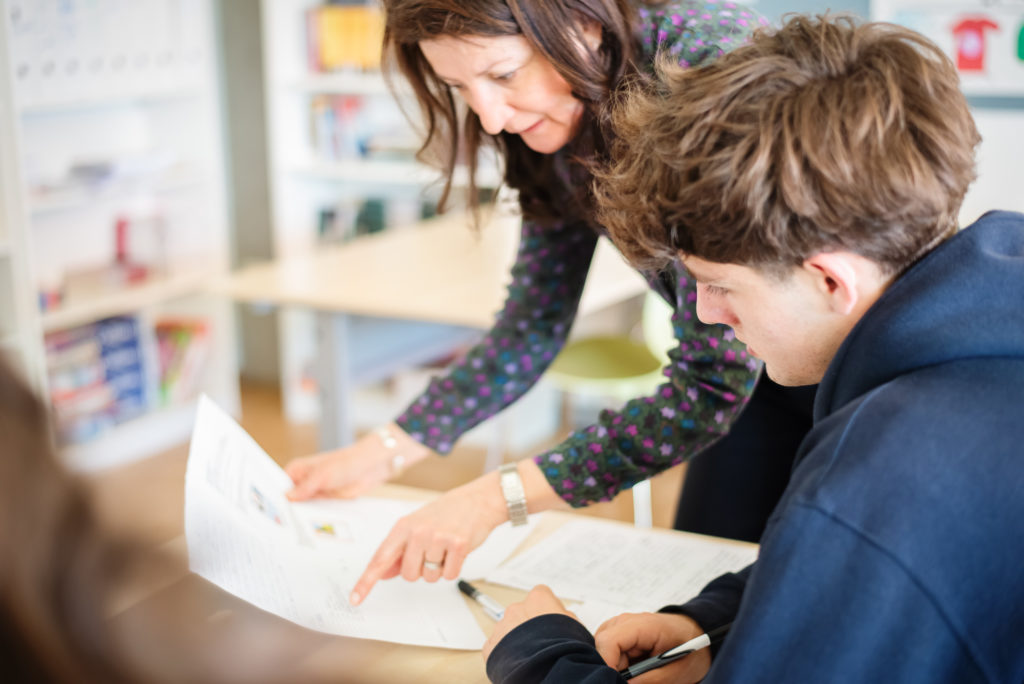
The answer, according to Dr Crisfield, starts with the curriculum rather than with support added on afterwards. Schools with a high number of language learners need a curriculum built around that reality from the start, not an imported curriculum patched up with extra support later.
Done well, a curriculum delivers content and language together. A child learns the subject and the language of instruction at the same time; neither should have to wait for the other.
Why does the home language matter so much?
Research shows a strong, two-way relationship between a child’s home language and their success in additional languages. It starts early: children with strong oral skills in their first language tend to pick up English or French more easily than children who already struggle in their own language.
That relationship holds right through school. Children who read and write well in their home language by the end of secondary school also show stronger results in the school language. A family cannot drop the language their child is strongest in and expect a new one to simply take its place. In practice, that tends to weaken both.
Where next for bilingual education?
Bilingual education isn’t new. It has existed around the world for decades, and it arrived relatively late in English-speaking countries and much of Western Europe. That’s starting to change.
Dr Crisfield notes that Canada’s French immersion programmes date back to the late 1960s, and that Spanish-English immersion has run in the US for decades too. More and more European countries now offer some form of bilingual education within their state systems, and international schools report higher demand from parents for programmes that offer more than English on its own.
What should parents do?
Dr Crisfield’s advice starts with the home language. Whatever languages a family speaks at home deserve an actual plan before a school adds a third or fourth. Parents can’t simply drop a language a child has spoken since birth and expect a clean swap for another; the path each language has already taken with a child matters.
Above all, she pushes back on the idea that children are sponges who absorb languages without effort. Some children take to languages easily. Others work hard for every one they learn — and a reluctant child pushed towards a language they feel no connection to rarely benefits from it. Her advice, in the end, is refreshingly simple: be a parent first, then think about the languages.
Emma Dowou
Haut-Lac Communications
About Dr Eowyn Crisfield
Dr Eowyn Crisfield is a specialist in language acquisition, bilingual education and multilingualism in schools. She works with schools around the world on language learning, and with families on family language planning. She is an Honorary Norham Fellow at the University of Oxford’s Department of Education, where she supports projects on English as an additional language and teacher training. She is the author of Bilingual Families: A Practical Language Planning Guide.
At Haut-Lac, this thinking sits behind our own bilingual programme. We build it around the children who walk through our doors each year, not around an idealised profile of who we wish they were.
For more on Haut-Lac’s approach to bilingual education, visit our website and/or contact admissions to see it in action for yourself.