


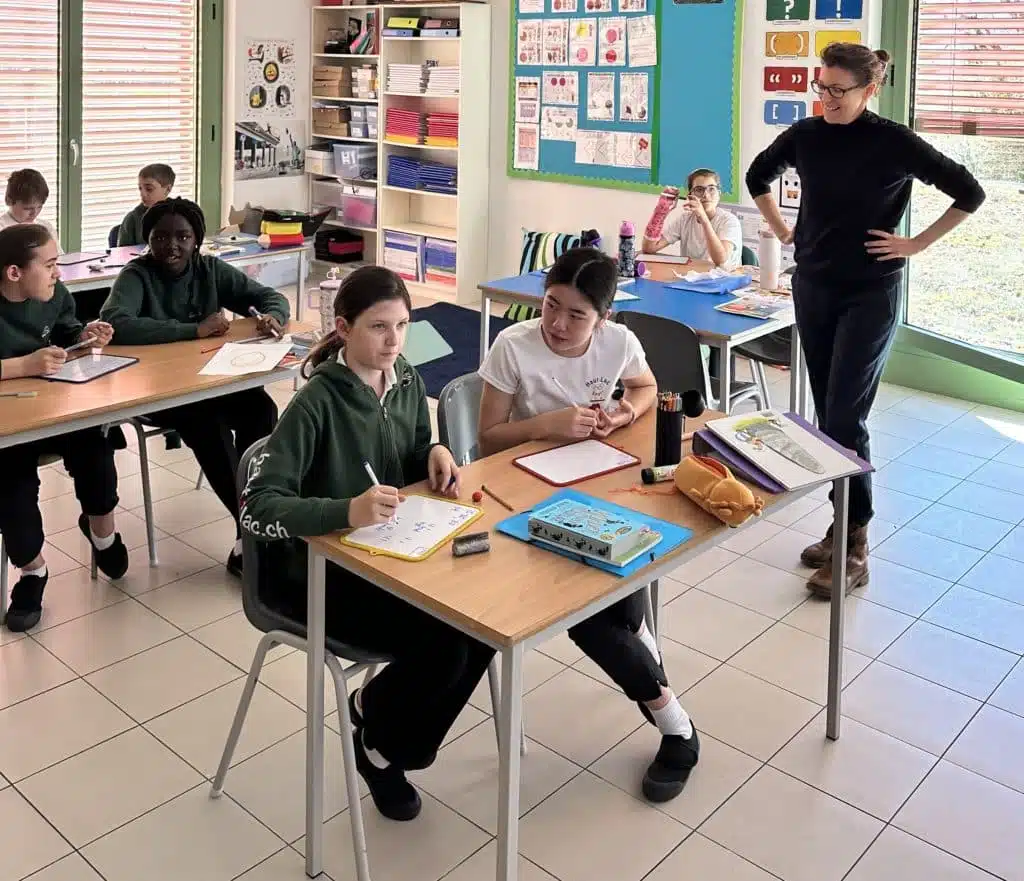
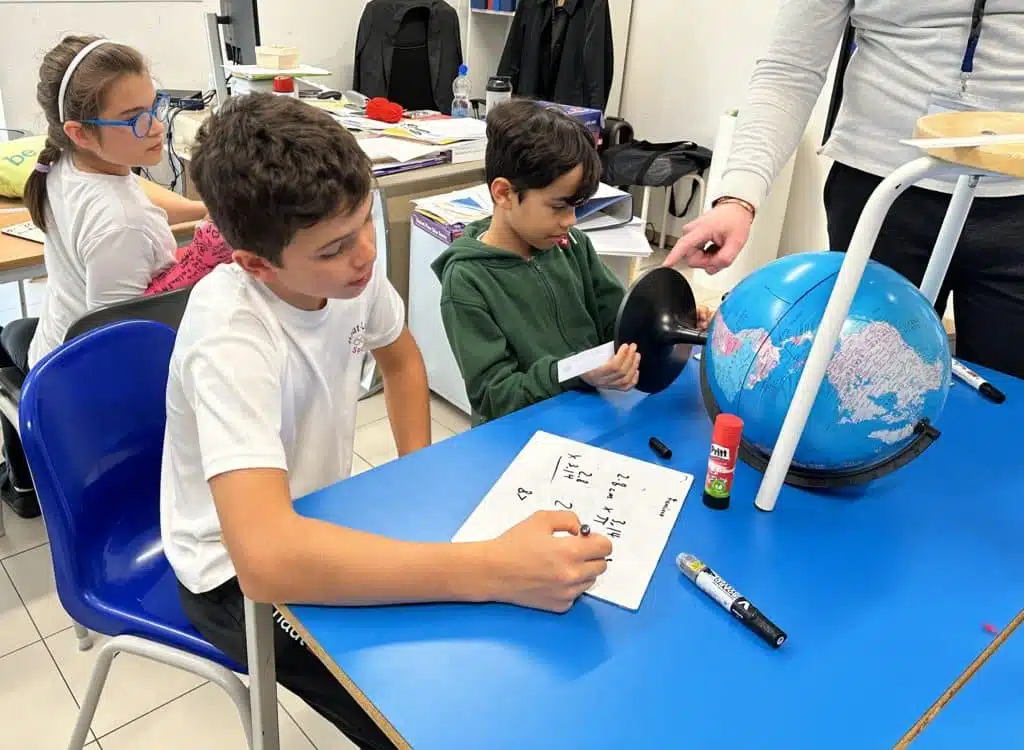
Our annual Pi Day events have the whole school buzzing. Students rotate through maths learning carousels, which include real-world pattern analysis, circumference measuring and multiplication competitions.
At Haut-Lac International Bilingual School, students develop conceptual mastery at their own pace and gain independence in their thinking by reasoning, explaining and discussing methods rather than simply chase the correct answer.
Why study maths bilingually
Oracy sits at the heart of everything that happens in our English and French maths lessons. The students don’t just learn to solve equations. They learn to explain their thinking in two languages.
Why does this matter? Because when a child can explain their method, discuss different strategies, and reason through problems out loud, they develop confidence that carries into every other area of learning. It’s an approach that strengthens language and numerical skills simultaneously.
As one Year 5 pupil explained:
“I solved it in French first, then explained it in English. It helped me understand it better.”
What you’ll see in our maths classrooms
Forget rows of silent children hunched over worksheets. Walk into any of our lessons and you’ll find:
- Manipulatives spread across tables to make abstract concepts tangible
- Visual representations that help students understand complex ideas
- Collaborative problem-solving as children work through challenges together
- Real-world applications from measuring and scaling in projects to exploring fractions with everyday examples
- Students applying their learning during events like Pi Day, where they measure real objects, calculate circumference, and explain their reasoning collaboratively in both languages
We follow the White Rose Maths framework, which ensures systematic progression and gives teachers room to tailor lessons to students’ interests and strengths.
The result? Children bring their enthusiasm and curiosity home, whether they’re calculating ingredients for a recipe or exploring patterns on a walk.
How we measure success in maths
Yes, we monitor assessment data. But we’re equally interested in growth across multiple dimensions:
| What we celebrate | What this looks like |
| Progress in assessment | Clear advancement through curriculum milestones |
| Growth in confidence | Students who confidently justify their reasoning and tackle unfamiliar problems |
| Independence | Learners who can tackle problems without constant guidance |
| Conceptual understanding | Children who grasp why methods work, not just how |
We focus on understanding rather than rote memorisation to help children see maths as a meaningful and empowering tool for everyday life.
Some learners progress quickly, whilst others need more time. But both are succeeding because we support each child to develop at their own pace whilst fostering independence in their thinking.
Why run enrichment events like Pi Day
Events like Pi Day have quickly become highlights of our school calendar. Beyond the competitions and excitement, these occasions provide opportunities for cross-year collaboration, creative thinking and communication through hands-on contexts, such as measuring, estimating, and problem-solving.
They’re more than celebrations; they’re a chance for children to experience maths as something dynamic, social and deeply rewarding.

How we build lasting confidence
What we’re really building here is a mindset. When children learn that collaboration strengthens their work, that reasoning matters as much as the correct answer, and that understanding trumps memorisation, they develop more than their numeracy skills.
They learn to approach challenges with curiosity rather than fear, explain their thinking clearly, and work together to solve problems whilst reflecting on different approaches.
Every child can succeed in maths when given the right support, challenge, and encouragement. The aim is to ensure each student leaves with strong numeracy skills, a lifelong love of learning, and belief in their own potential as mathematicians.

Zac Casey
Primary Maths Subject Leader
Haut-Lac International Bilingual School