

Summary: Choosing a Swiss boarding school comes down to looking past the prospectus. The schools that suit your child best will be the ones whose curriculum, boarding model, language of instruction, location, accreditations, and fee structure all line up with what you’re actually looking for. Visiting in person is what makes the difference between a shortlist and a decision.
Switzerland has been a global reference point for boarding education since the late 19th century. Most families who end up sending their child here start from the same place: a long list, a lot of glossy websites, and the nagging worry that every school sounds a bit like the next.
So how do you actually tell them apart?
Here’s a practical guide for parents and students researching boarding schools in Switzerland, with a few honest insights from our own community at Haut-Lac International Bilingual School on the Swiss Riviera.
Compare curricula before anything else
The academic programme shapes everything that follows, from daily timetables to university options.
Swiss boarding schools typically offer two or three of the following pathways: the International Baccalaureate (IB), British A-Levels, the American High School Diploma, the Swiss Matura, or the French Baccalauréat. Each has its strengths, for example the IB Diploma is recognised by universities in over 90 countries, including Switzerland, and suits students who want academic breadth alongside depth.
One question worth asking every school: where do your graduates end up? University destinations reveal more about academic strength than any prospectus. Haut-Lac students, for example, have recently gone on to EPFL, the University of Cambridge and Stanford after completing personalised IB Diploma, IB Career-Related or US High School diploma programmes.
Types of Swiss boarding schools: full, weekly, and boutique
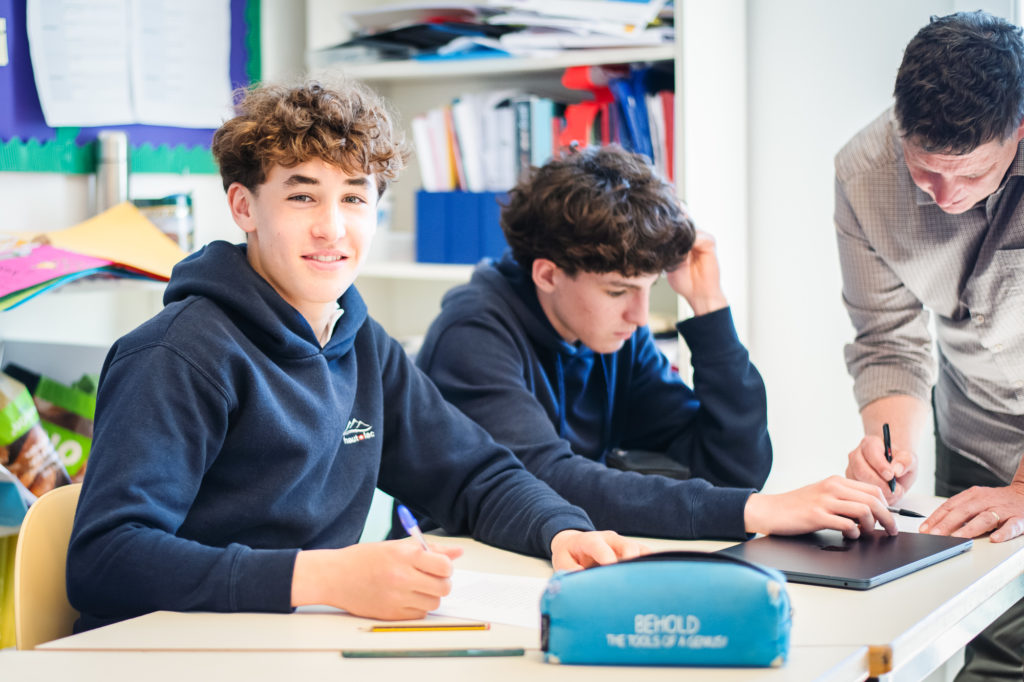
“Boarding school” covers a surprisingly wide spectrum in Switzerland. Full boarding schools have students on campus seven days a week. Others offer weekly or flexi-boarding. A smaller number, Haut-Lac included, run what’s often called boutique boarding: a tight-knit residential community within a larger day school.
Each model suits a different kind of student. Full boarding can feel immersive but isolating. Day-heavy schools with a boarding wing tend to offer better local integration and closer contact with staff.
“Despite being a small boarding house, Haut-Lac does not limit social opportunities in any way. Students are fully integrated with day students, which significantly broadens their social circle. […] The possibility of spending weekends at friends’ homes is also particularly valuable, contributing to a more natural and enriching experience.”- Parent of an IB1 boarder at Haut-Lac
At Haut-Lac, boarding parents live on site and are present 24/7. The boarding team meets weekly with the secondary academic team, so a student struggling in class never becomes a student struggling in silence.
Bilingual boarding schools in Switzerland
Switzerland has four national languages, and its schools reflect that. Some teach exclusively in English. Others, like Haut-Lac, are genuinely bilingual in English and French from age three onwards.
If bilingualism matters to you, ask how it’s actually delivered. Two hours of French a week is language class, not bilingual education. Real bilingual schooling means shared subject teaching across two languages, daily immersion, and a community where native speakers are the norm, not the exception. At Haut-Lac, 67% of students and staff are native English or French speakers.
For a fuller picture, our Mythbusting Bilingualism blog post covers what the research actually says.
Location, access and weekend life
Where a school sits in Switzerland changes daily life more than most families expect. Canton of Vaud, Valais, central Switzerland, the Lake Geneva basin: each has its own character, climate, and transport links.
Two practical considerations matter most:
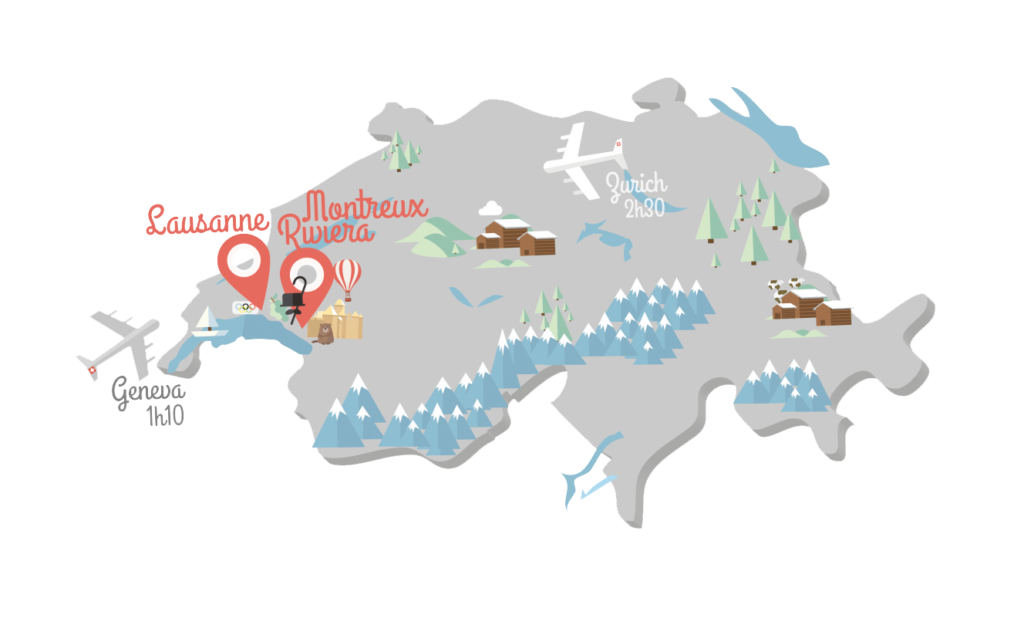
- Airport access. Geneva and Zurich are the main hubs for international families. Proximity saves hours at half-term.
- Weekend options. Can students reach the mountains, the lake, or a lively town without a three-hour journey?
Haut-Lac scores well on both counts, which is one of the reasons families from across Europe, the Middle East, and Asia choose us. Our campus is in Saint-Légier-La Chiésaz, 20 minutes from Lausanne and a short train ride from Montreux, Vevey and Geneva airport. That means weekends can stretch from skiing in Portes-du-Soleil to a trip to Milan without anyone spending a day on a coach.
Wherever you look, visit in person if you can. Most Swiss boarding schools welcome tours, and nothing else gives you the same feel for how a school actually runs. You can book a tour at Haut-Lac here.
Questions to ask on every school visit
The polished tour covers what the school wants you to see. These questions get at what it’s actually like to live there:
- What’s the student-to-staff ratio in the boarding house, especially at night and weekends?
- How are weekends structured, and how much choice do students have?
- What pastoral support is in place for homesickness, mental health, and academic pressure?
- How does the school support university applications in the UK, US, Switzerland, and beyond?
- What’s the nationality mix? (Haut-Lac currently welcomes 600 students from 64 countries.)
- How often do boarding parents and class teachers communicate?
Accreditations and what they actually mean
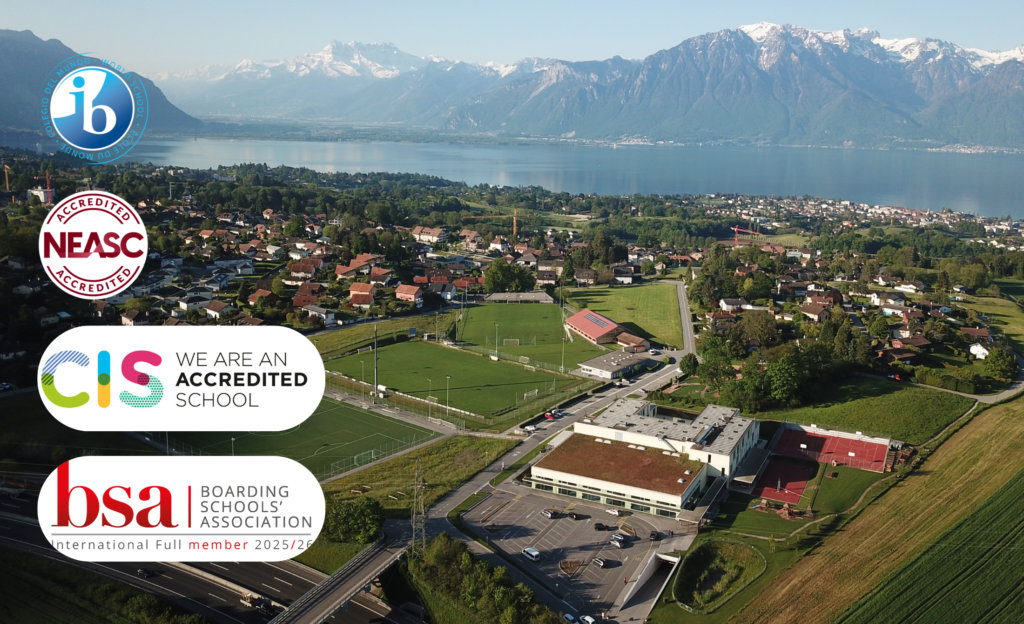
Credentials aren’t just logos on a website. They signal that a school has been independently inspected against international standards.
The ones worth looking for:
- Council of International Schools (CIS) — evaluates governance, safeguarding, and learning outcomes.
- NEASC — a US-based accreditor with a strong international reputation.
- Boarding Schools’ Association (BSA) — the UK body whose standards cover boarding welfare and practice. Full membership is significant.
- Swiss Federation of Private Schools — the national body for private education in Switzerland.
Haut-Lac holds full membership of all four, and is accredited as an IB World School as well as a top-10 ranked IB school in Switzerland.
Swiss boarding school fees: what’s actually included
Fees vary widely across Swiss boarding schools, and the headline figure rarely tells the whole story.
Some schools quote an all-in number. Others charge separately for ski trips, laundry, laptops, weekend excursions, airport transfers, and personal expenses. When you request fee information, ask for a fully itemised breakdown and an estimated total including the extras.
Think about value, not just cost. University outcomes, pastoral care, small class sizes, and the long-term alumni network all matter. Swiss boarding tends to be expensive, but the quality of pastoral care and academic guidance is often what families remember decades later.
The final check
After the research, the visits, and the spreadsheets, pay attention to one more thing: how your child feels walking around the school. Do they relax or tense up? Do they ask the current students questions? Can they see themselves there on a rainy Tuesday in February?
Boarding is about belonging as much as learning. That’s the test that matters most.
If you’d like to learn more about boarding at Haut-Lac, you can get in touch with our admissions team or explore our boarding pages online.
Emma Dowou
Haut-Lac Alumna