Our children’s future will be shaped by artificial intelligence and technology we can barely imagine today. That’s why STEM education at Haut-Lac focuses on building the thinking skills they’ll actually need, rather than memorising facts that might be outdated before they graduate.
From preschool counting games to advanced IB research projects, students learn to think like mathematicians, scientists and innovators. They tackle real problems, write code that works, and design solutions that make a difference.
When they leave us, they’re ready for whatever comes next – university, career changes or challenges we haven’t even thought of yet.


At Haut-Lac, science is a dynamic journey of discovery that connects everyday experiences with the wonders of the scientific world.
Our bilingual English and French science programme goes beyond textbooks. Students ask questions, think critically and explore the “why” and the “how” of the world around them through:
Our IBMYP, IBDP and IBCP programmes prepare secondary students to tackle complex scientific challenges through rigorous investigation and critical analysis.
They work with professional-grade equipment, explore ethical implications of scientific advancement, and develop the sophisticated research skills that will distinguish them after graduation.
The core elements below shape how students experience the IB science programmes at Haut-Lac:
Balancing an IB timetable with serious training and competition isn’t simple. It helps to have someone who understands both sides of that equation.
That’s the Student-Athlete Coordinator. They sit between the student, their club or coach, and the school’s academic team, so nothing falls through the gaps when a competition clashes with a class. If a student has to miss school for training or a tournament, the coordinator lets teachers and academic leaders know, and helps put a plan in place to catch up on the work.
They’re also someone students and families can turn to for advice or support, whatever comes up. And they bring in outside expertise too, arranging talks with professional athletes and health specialists so student-athletes can learn from people who’ve been through it themselves.

“What motivates me every day is helping students develop their curiosity, creativity and self-confidence. I place great importance on creating meaningful, engaging and differentiated learning experiences that meet the needs of every learner. I also enjoy supporting teachers and working collaboratively to build a positive and dynamic learning culture.”

“My experience in industry taught me about the importance of the application of theory to practical solutions, that most innovation happens when different disciplines work together, and that any solution is of limited value unless you can explain to people how it works.
Retraining as a Chemistry teacher helped me rediscover my passion for the subject. Once you understand the principles of Chemistry, you can see how interactions at the atomic level determine the properties of everything that makes up the world, and yet Chemistry is sometimes unpredictable and continues to surprise us with its depth and variety. ”
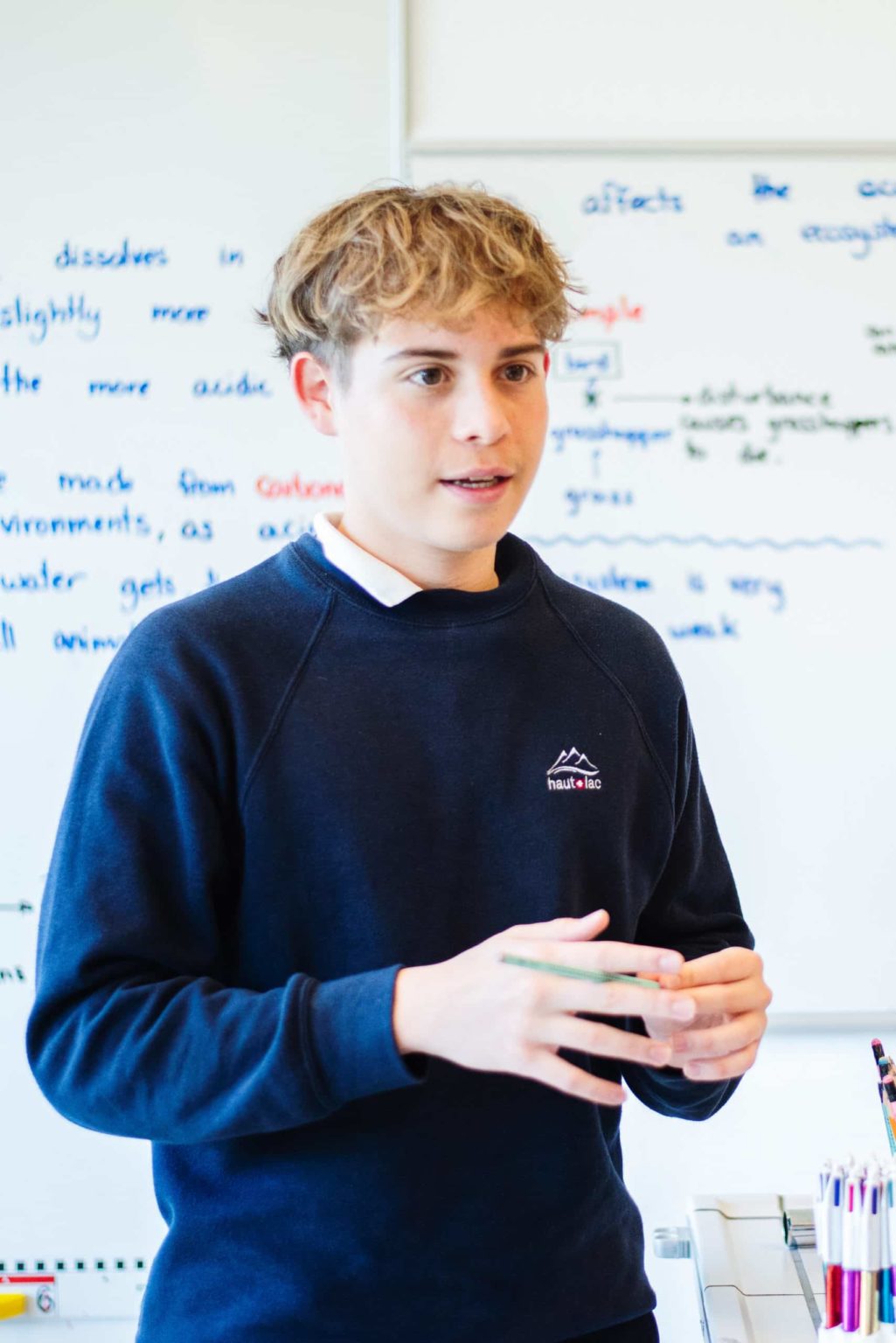

Watch a four-year-old discover that ten twenty-centime coins equal one two-franc coin, and you’ll witness the exact moment mathematical thinking begins.
At Haut-Lac, we nurture that natural curiosity from early years counting games to complex IB concepts.
Our bilingual maths programme builds confidence through:
Your child will enter a world where computational thinking drives innovation in every field, from medicine to environmental science. That’s why our ICT programme extends past basic digital literacy.
Our students start with playful exploration in preschool and evolve into sophisticated programmers by graduation.
Each step builds the technical confidence and ethical foundation they’ll need for university and the workplace through four key pillars:
Students learn to break down problems, spot patterns and design logical solutions that strengthen their work across all subjects.
Computer Science starts as a dedicated subject in Primary, continues through Design classes in the IBMYP, and becomes an IB Diploma option at the end of secondary school. This progression develops the technical ability and logical reasoning students need for university and professional success.
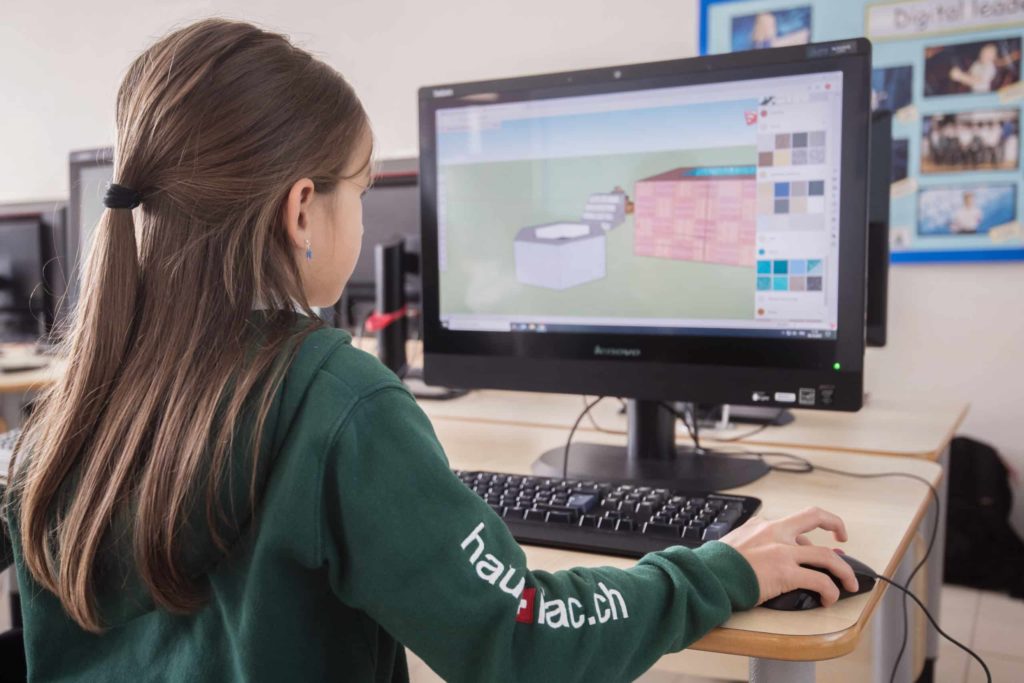
We prepare students to use technology with confidence and responsibility. They explore online safety, data protection and digital ethics, while considering how technology shapes society.
This foundation helps them create positive digital footprints and make thoughtful choices in the digital world.
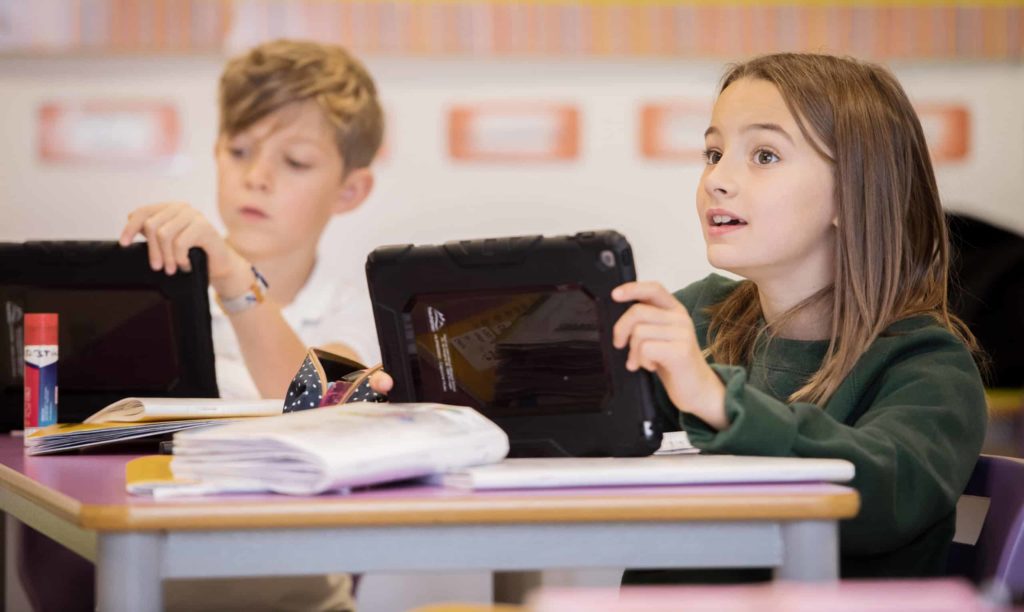
From robotics clubs to multimedia design, students experiment, test and collaborate to transform concepts into working creations.
This practical approach nurtures imagination, resilience and the skills to turn technology into a tool for innovation.

Digital literacy runs from primary through to the end of secondary. Students develop skills in research, collaboration and digital communication, whilst exploring the ethical use of emerging technologies like artificial intelligence.
ICDL clubs also enable secondary students to boost their practical digital skills according to the International Computer Driving Licence curriculum.
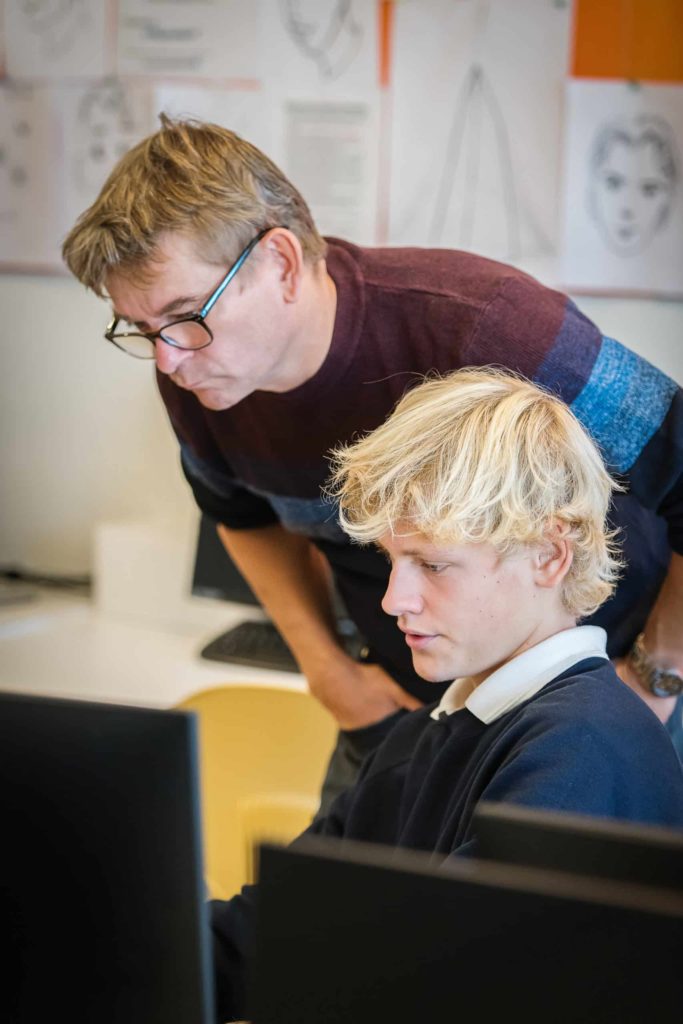

The design cycle is a practical way to help students see connections between subjects and apply creative thinking in unexpected contexts.
By using it, independently and in teams, to find solutions to mathematical problems, historical investigations and scientific inquiries, students get very good at:
At Haut-Lac, we’ve found the sweet spot between traditional educational means and digital tools. Students still write by hand, sketch ideas on paper, and engage in face-to-face discussions whilst leveraging technology to deepen understanding and expand possibilities.
This balanced approach extends throughout our programmes, from design studios where laser cutters and 3D printers work alongside hand tools, to classrooms where iPads enhance rather than replace fundamental learning skills.
It’s an approach that grows with each student’s maturity and needs:
Interested in science and technology?
Find out how we shape the researchers, mathematicians and engineers of tomorrow on our school blog.

Haut-Lac students learn science through an inquiry-based approach across all age groups.
In Primary, children investigate, classify, test, analyse and evaluate in our fully-equipped science laboratory and outdoor discovery garden. They learn to question, hypothesise and draw conclusions from their experiments.
The IB MYP integrated science course encourages middle school students to actively research scientific theory, design and perform investigations, form conclusions and suggest alternative explanations.
In the IB Diploma Programme, students design sophisticated experiments, manipulate data with professional equipment and interpret results in terms of the wider scientific landscape. This hands-on approach helps them develop both practical and mathematical skills embedded in the natural sciences.
Yes, students regularly participate in workshops led by scientific experts and visit research facilities such as CERN and the University of Lausanne laboratories.
These experiences help students see science in action beyond the classroom and connect their learning to real scientific work.
Students can also join extra-curricular STEM clubs to further broaden and deepen their knowledge and skills.
Yes, inquiry-based learning is at the heart of our science teaching from age 3 through to the IB Diploma.
This approach enables students to develop analytical and creative skills by actively researching scientific theory, designing their own investigations and forming conclusions.
Rather than simply memorising facts, students learn to think like scientists. They ask questions, test hypotheses and develop evidence-based explanations for the phenomena they observe.
Students explore scientific concepts through experimentation in our fully-equipped laboratories rather than learning purely from textbooks. They design investigations, collect and analyse data, and draw conclusions based on their findings.
Throughout the curriculum, students connect their learning to real-world contexts, from everyday phenomena in Primary to complex scientific challenges in high school. This approach prepares students to become inquisitive and thoughtful young scientists, with many graduates going on to pursue their passion for science at top universities including EPFL and MIT.
Our science programme builds progressively from the infant section through to high school.
Primary (ages 3-11):
Students study the sciences through real-world themes according to the Learning Means the World curriculum. We’re also the only non-UK school to receive the Primary Science Quality Mark for our outstanding delivery of science education.
Middle School (ages 11-15):
Students follow the IB MYP integrated science course, which explores biology, chemistry and physics concepts together. The syllabus helps students understand the critical role science plays in everyday life by exploring science through different lenses, including morality and ethics.
High School (ages 16-18):
Students study individual science disciplines (Biology, Chemistry, Physics Environmental Systems & Societies or Computer Science) as part of the IB Diploma or Career-related Programme.
In middle school (ages 11-15), students study science as an integrated subject that combines biology, chemistry and physics concepts.
In high school (ages 16-18), students study individual science disciplines. Haut-Lac offers IB Diploma Biology, Chemistry, Physics, Environmental Systems & Societies and Computer Science.
Students typically take one or two sciences depending on whether they’re pursuing science-focused careers or maintaining a broader curriculum. This allows them to specialise in areas relevant to their interests and university plans.
Haut-Lac students have access to fully-equipped science laboratories with modern equipment for hands-on experimentation and research.
Primary students also use our outdoor discovery garden for investigations.
The school provides iPads, interactive whiteboards and eLearning platforms to support differentiated learning. These digital tools help teachers tailor the experience to individual students’ needs whilst developing communication, collaboration and critical thinking skills.
Students also extend their learning through visits to world-class research facilities like CERN and the University of Lausanne laboratories, workshops with scientific experts, and extra-curricular STEM clubs including programming and robotics.
Yes, technology education is built into the curriculum through three pillars: Computer Science, New Technologies for Learning and Teaching, and Digital Citizenship.
Students have dedicated computer science lessons where they learn about networks, communication and programming. The school also runs programming and robotics clubs for those who want to develop their technology skills further.
Computer Science is available as an IB Diploma Programme option for students pursuing technology studies in depth. This curriculum evolves to keep pace with emerging technologies.
Encourage curiosity by exploring everyday phenomena together. Ask “why” and “how” questions about things you observe, from cooking reactions to weather patterns.
Support hands-on exploration. Simple home experiments using household items can spark fascination with scientific concepts.
Visit science museums, planetariums and natural history exhibits to see science in different contexts. Talk about what your child is learning in their science lessons and look for connections to the world around you.
Most importantly, show enthusiasm for scientific discoveries and celebrate the process of asking questions and testing ideas, not just getting the “right” answer.
Yes, students use fully-equipped science laboratories throughout their time at Haut-Lac.
Primary students have access to a dedicated science laboratory where they carry out investigations and experiments. They also use our outdoor discovery garden for hands-on exploration.
Secondary students use specialist science laboratories fitted with modern equipment for experimentation, research and data logging.